




Advanced LED Measurement Techniques and Standards: Ensuring Precision in Photometric and Radiometric Characterization
Introduction to Modern LED Metrology
The proliferation of Light Emitting Diode (LED) technology across diverse industrial and scientific domains has necessitated a concomitant evolution in measurement methodologies. Unlike traditional incandescent sources, LEDs exhibit characteristics—including spectral discreteness, directional emission, sensitivity to thermal and electrical operating conditions, and temporal instability—that render conventional measurement techniques inadequate. Accurate characterization is therefore paramount, not only for product specification and quality assurance but also for compliance with stringent international standards governing performance, safety, and human-centric lighting. This article delineates advanced techniques and standards for LED measurement, with a focus on integrated sphere-spectroradiometer systems as the cornerstone of modern photometric and radiometric laboratories.
Fundamental Principles of Integrating Sphere-Based Measurement
The integrating sphere, a hollow spherical cavity with a highly reflective, diffuse inner coating, serves as the primary tool for measuring total luminous flux, the foundational photometric quantity. Its operation is predicated on the principle of spatial integration; light entering the sphere undergoes multiple diffuse reflections, creating a uniform radiance distribution across the sphere’s inner surface. A detector, shielded from direct illumination by a baffle, samples this uniform radiance, which is proportional to the total flux of the light source. For spectrally selective sources like LEDs, a spectroradiometer, rather than a broadband photometer, is typically employed at the sphere’s exit port. This configuration enables the simultaneous acquisition of the absolute spectral power distribution (SPD), from which all photometric (e.g., luminous flux, chromaticity coordinates, correlated color temperature – CCT) and colorimetric (e.g., Color Rendering Index – CRI, TM-30 metrics) parameters can be derived with high accuracy. Critical considerations in sphere design include sphere diameter (to minimize self-absorption errors from the test device), coating reflectance and diffusivity, and the precise placement of baffles and auxiliary lamps for sphere efficiency correction.
Spectroradiometric Fidelity in SPD Acquisition
The spectroradiometer is the analytical engine of advanced LED measurement. Its fidelity in capturing the SPD directly dictates the uncertainty of all derived parameters. Key specifications include wavelength accuracy (typically within ±0.3 nm), wavelength repeatability, spectral bandwidth, stray light rejection, and dynamic range. The measurement of narrow-band LEDs, such as those used in horticultural lighting or indicator applications, places a premium on high spectral resolution. Conversely, the accurate measurement of saturated colors and the calculation of extended indices like the gamut area index (GAI) or melanopic equivalent daylight illuminance require excellent stray light performance. Calibration traceability to national metrology institutes (NMIs) via standard lamps is non-negotiable for absolute measurements. Furthermore, the linearity of the detector system across its operational range must be verified, as the high peak irradiance of certain LEDs can induce nonlinear responses in silicon detectors.
Addressing LED-Specific Measurement Challenges: Thermal and Electrical Dependence
LED performance is intrinsically linked to its junction temperature and drive current. A comprehensive characterization must therefore account for these dependencies. Advanced testing systems incorporate temperature-controlled mounts and pulse-width modulation (PWM) or constant current drivers capable of operating the LED under test (DUT) at specified thermal and electrical setpoints, as mandated by standards such as IES LM-85 (for LED packages and arrays) and IES LM-79 (for LED luminaires). Measurements should be taken only after the DUT has reached thermal and photometric steady-state, a condition that can be monitored via a photometric monitoring detector within the sphere. The ability to measure at elevated ambient temperatures is particularly critical for industries like automotive lighting, where LED modules must be characterized under hood temperatures exceeding 85°C, or aerospace, where reliability across extreme thermal cycles is essential.
Goniophotometry for Spatial Distribution Analysis
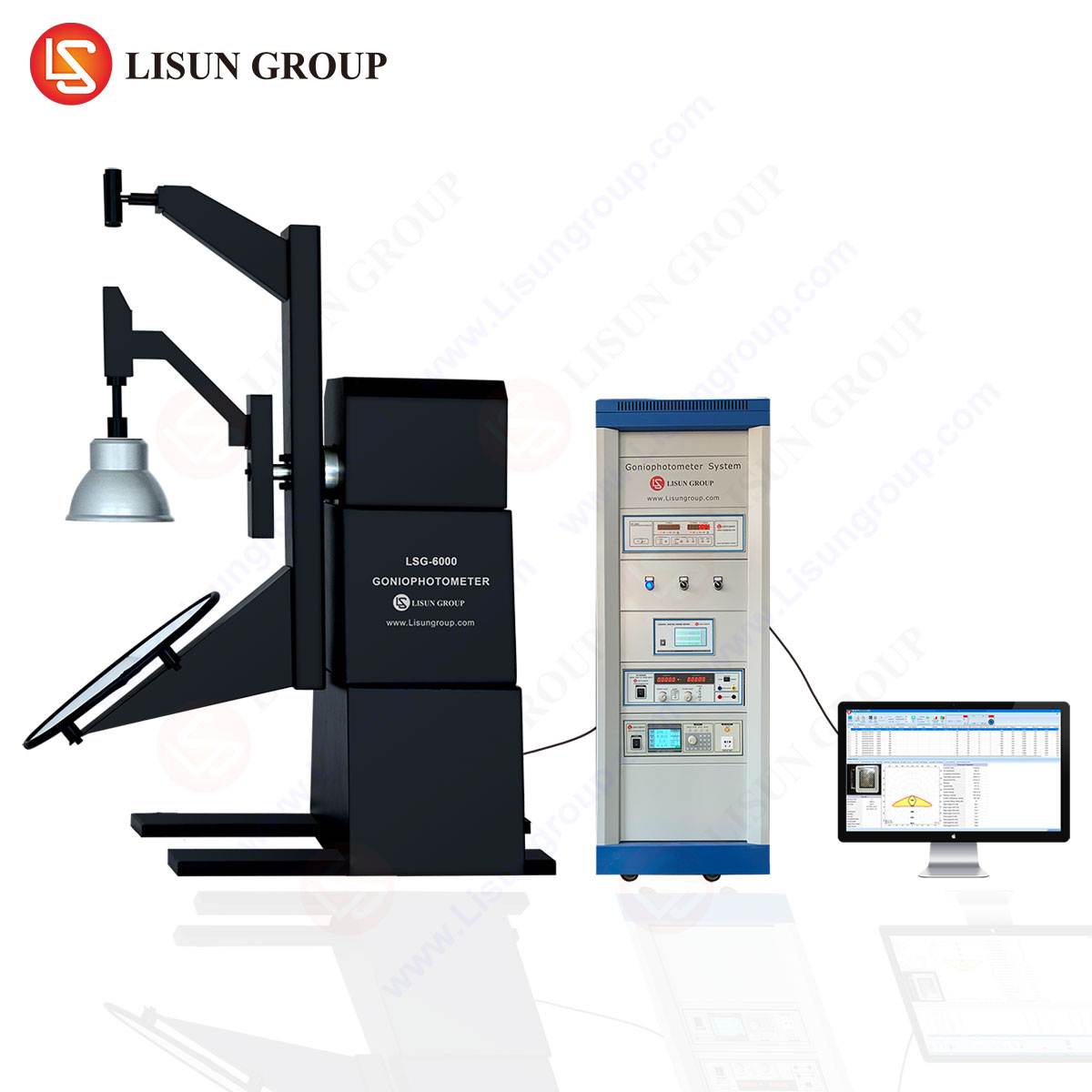
While integrating spheres measure total flux, the spatial distribution of light—intensity, luminance, and flux per solid angle—is quantified using goniophotometers. A Type C (moving detector) goniophotometer rotates a spectroradiometer or photometer around a fixed luminaire, mapping its far-field intensity distribution. This data is indispensable for calculating zonal lumen summaries, efficiency, and for generating IES or EULUMDAT files used in lighting design software. For applications in urban lighting design, marine navigation lights, and automotive headlamp testing, the precise beam pattern and cutoff lines defined by goniophotometric measurements are legally regulated. The convergence of sphere-derived total flux and goniophotometer-derived intensity distribution provides a complete photometric profile of a luminaire.
Industry-Specific Standards and Metrics
Compliance with industry-specific standards is a primary driver for advanced measurement.
- Lighting & Display: IES LM-79, LM-80, LM-82; ANSI C78.377; IEC 62931; for displays, VESA DisplayHDR and associated color gamut measurements.
- Automotive: SAE J578 (color), J1889 (LED modules), J2560 (photometry); ECE regulations for signal and headlight functions.
- Aviation: FAA TSO-C33, DO-160 environmental testing; precise chromaticity requirements for runway and aircraft position lights.
- Medical: IEC 60601-2-41 for surgical luminaires, including color rendering and shadow dilution specifications.
- Photovoltaics: While not an illumination application, spectroradiometers are critical for measuring the spectral irradiance of solar simulators per IEC 60904-9, which determines the testing conditions for solar cells and modules.
Emerging metrics, such as those outlined in IES TM-30-20 (Rf, Rg), and standards for human-centric lighting focusing on melanopic lux, require full SPD data with high colorimetric accuracy, further underscoring the need for precision spectroradiometry.
The LPCE-3 Integrated Sphere and Spectroradiometer System: A Paradigm for Conformity Testing
The LISUN LPCE-3 High Precision Integrating Sphere Spectroradiometer System exemplifies the integration of the principles discussed above into a turnkey solution for advanced LED testing. It is designed to meet the exacting requirements of standards such as LM-79-19, LM-80, ENERGY STAR, and IESNA.
System Specifications and Testing Principles
The LPCE-3 system typically comprises a large-diameter integrating sphere (e.g., 2m for luminaires), an internally mounted high-precision CCD array spectroradiometer (LMS-9000/9500 series), a temperature-controlled LED power supply, and a master control software suite. The sphere interior is coated with BaSO4, a spectrally neutral diffuse material with reflectance exceeding 97% from 380-780nm, minimizing spectral distortion. The spectroradiometer offers a wavelength range of 380-780nm (extendable to 1000nm for IR LED testing), with a bandwidth of approximately 2nm, ensuring precise resolution of LED spectral peaks.
The system employs a 4π geometry for luminaire testing and a 2π geometry with a reflective plate for light source testing. It automates the spectral correction factor calculation using an auxiliary lamp to account for sphere imperfections and the self-absorption of the DUT—a critical step often overlooked in rudimentary systems. The software calculates over 30 photometric and colorimetric parameters from a single measurement scan, including Luminous Flux (lm), Luminous Efficacy (lm/W), CIE Chromaticity Coordinates (x, y, u’, v’), CCT (K), CRI (Ra), TM-30 (Rf, Rg), Peak Wavelength, Dominant Wavelength, FWHM, and Spectral Power Distribution graphs.
Industry Use Cases and Application
The LPCE-3 system finds application across the breadth of industries requiring precise optical measurement:
- LED & OLED Manufacturing: For binning LEDs by flux and chromaticity, verifying OLED panel uniformity and color performance.
- Automotive Lighting Testing: Characterizing the total flux and color of interior LED clusters, signal lamps, and headlamp modules under controlled temperature conditions.
- Aerospace & Aviation: Validating the luminous intensity and chromaticity of cockpit displays and exterior navigation lights to strict aviation authorities’ standards.
- Display Equipment Testing: Measuring the absolute luminance, color gamut, and uniformity of LCD, OLED, and micro-LED displays.
- Scientific Research Laboratories: In photobiological research, horticultural lighting studies, and material testing under specific spectral irradiance.
- Stage & Studio Lighting: Quantifying the output and color rendering properties of LED-based fresnels, profiles, and wash lights for specification and design.
- Medical Lighting Equipment: Certifying surgical lights for color rendering index and spectral distribution as per medical device regulations.
Competitive Advantages in Precision Measurement
The LPCE-3 system offers distinct advantages that address the limitations of piecemeal or less sophisticated setups. Its primary advantage is system-level calibration and integration. The spectroradiometer and sphere are calibrated as a unified system against NMI-traceable standards, reducing chain-of-calibration errors. The automated self-absorption correction routine enhances accuracy, particularly for large or uniquely shaped luminaires that absorb a significant portion of their own reflected light within the sphere. The inclusion of a programmable, temperature-stabilized DC power supply allows for characterization across the LED’s operational envelope, not just at a single nominal current. Finally, the comprehensive software not only reports standard metrics but also facilitates data logging, batch testing, and direct report generation in formats required for regulatory submission.
Future Trajectories: From Photometry to Networked Photonics
The future of LED measurement lies in the convergence of optical metrology with digitalization and application-specific biologics. The rise of Li-Fi, visible light communication (VLC), and smart lighting systems will require measurements of modulation depth and frequency response. The increasing importance of non-visual effects of light will drive the standardization of metrics beyond melanopic lux, potentially requiring spectroradiometers with extended range into the near-UV and near-IR. In research and development, especially for horticulture and health, the ability to measure and customize the photon flux density (PFD) across specific wavebands (e.g., photosynthetic photon flux density – PPFD) will become routine. Advanced systems will thus evolve from being mere compliance tools to integral components in the design feedback loop, enabling the optimization of LEDs for human-centric, biological, and data-centric applications.
FAQ Section
Q1: Why is an integrating sphere necessary if a goniophotometer can measure total flux by integrating intensity over all angles?
While a goniophotometer can mathematically derive total luminous flux, the process is time-intensive, requiring measurements at thousands of discrete angles. An integrating sphere provides a direct measurement of total flux in a single, rapid acquisition, making it vastly more efficient for production testing and quality control. The two instruments are complementary, with the sphere excelling at total flux and color, and the goniophotometer excelling at spatial distribution.
Q2: For measuring the color of an LED display, is an integrating sphere system like the LPCE-3 appropriate?
For measuring the absolute luminance and chromaticity of a display as a whole, or for calibrating a display’s built-in color sensor, a sphere-based system is ideal. However, for measuring spatial uniformity, contrast ratio, or the color of individual pixels, a imaging colorimeter or spot spectroradiometer is the correct tool. The LPCE-3 is best suited for measuring the integrated output of a display module when placed inside the sphere.
Q3: How does the LPCE-3 system account for the heat generated by a high-power LED luminaire during testing?
The LPCE-3 system’s software requires the user to input the thermal stabilization criteria (e.g., flux variation <0.5% over 5 minutes). It monitors the output via a dedicated monitoring detector in the sphere. Measurements are only triggered automatically once the DUT has reached this steady-state condition, ensuring data is representative of stable operation. The system's power supply can also log forward voltage, which correlates with junction temperature.
Q4: What is the significance of the sphere’s diameter?
A larger sphere diameter reduces the error caused by self-absorption, where the test object absorbs a portion of the light reflected from the sphere wall. It also accommodates larger, physically bigger luminaires. For compact light sources, a smaller sphere (e.g., 1m) offers higher signal-to-noise ratio. The 2m sphere in a typical LPCE-3 configuration provides an optimal balance for testing most commercial and industrial luminaires.
Q5: Can the LPCE-3 system measure flicker or temporal light modulation?
The standard LPCE-3 system with a CCD spectroradiometer is not designed for high-speed temporal measurement. Flicker metrics (percent flicker, flicker index) require a high-speed photodetector and oscilloscope or specialized flicker meter. However, the system’s core function of providing accurate SPD, flux, and color is a prerequisite for characterizing the underlying source before assessing its temporal modulation characteristics.