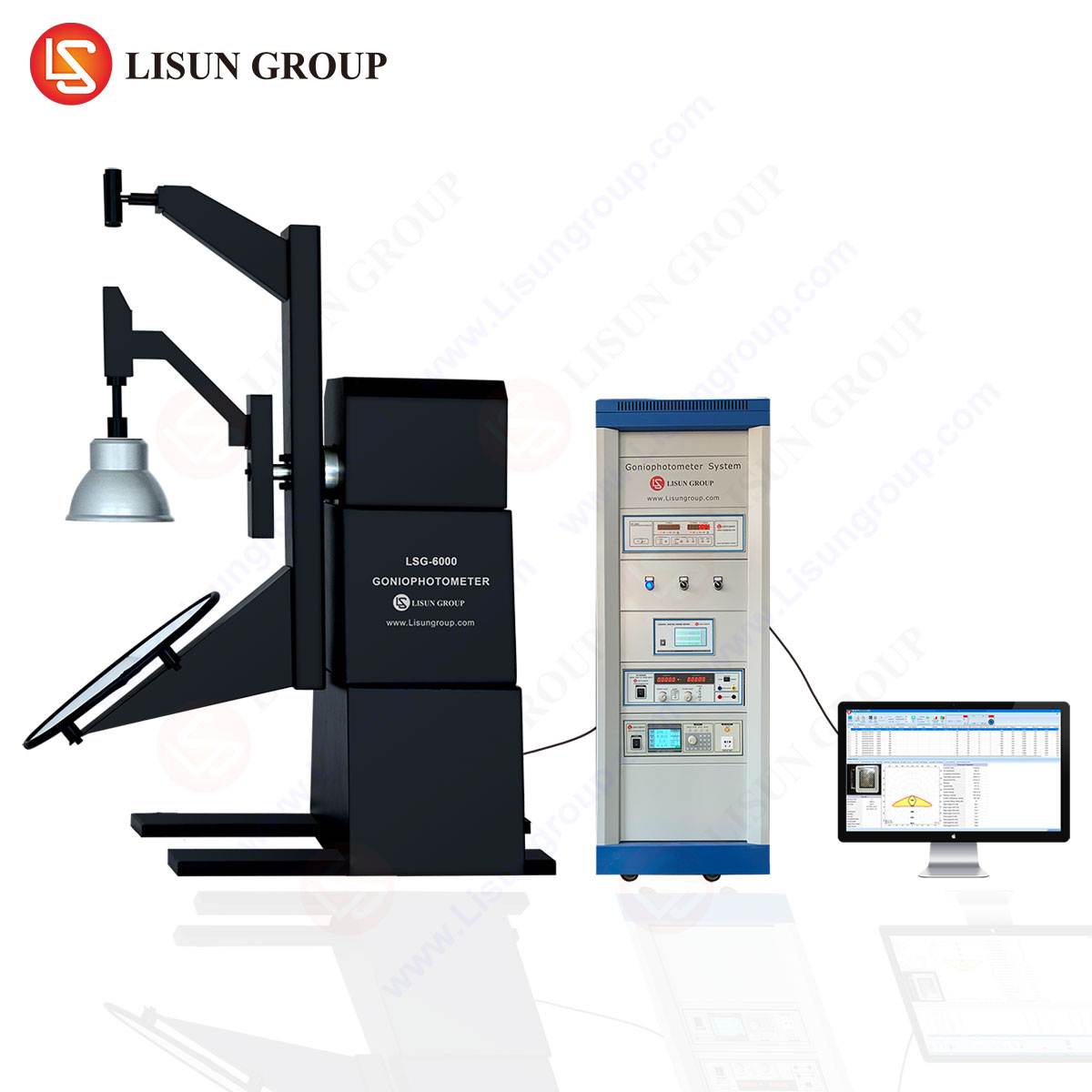



Advanced Goniophotometric Characterization for Solid-State Lighting Systems
The proliferation of Light Emitting Diode (LED) technology across diverse sectors has necessitated a paradigm shift in photometric and colorimetric measurement methodologies. Unlike traditional incandescent sources, LEDs are inherently directional, compact, and exhibit spectral and thermal characteristics that significantly influence their luminous output. Conventional integrating sphere methods, while valuable for total luminous flux measurement, are insufficient for characterizing the spatial distribution of light, which is critical for application efficacy. Goniophotometry, the technique of measuring a light source’s angular properties, has thus become the cornerstone of advanced LED validation. This article delineates the principles and applications of modern automated goniophotometer systems, with a specific examination of the LSG-6000, an instrument engineered to meet the rigorous demands of contemporary international standards.
Fundamentals of Goniophotometric Measurement
A goniophotometer functions by rotating a photodetector around a fixed light source, or conversely, rotating the source relative to a fixed detector, across two orthogonal axes: the vertical (C-axis, or gamma) and the horizontal (B-axis). This motion traces a virtual sphere around the Device Under Test (DUT), capturing luminous intensity data at a high density of angular coordinates. The resultant dataset is a three-dimensional intensity distribution, often represented as an I-file or an Eulumdat file, which serves as the foundational input for lighting design software.
The primary quantities derived from this spatial scan include:
- Luminous Intensity Distribution: The candela values as a function of angle, defining the beam shape, beam angle, and field angles.
- Total Luminous Flux (Φ): Calculated by integrating the intensity distribution over the entire 4π steradian solid sphere. This method, prescribed by standards such as CIE 121 and IESNA LM-79, is considered more accurate for directional sources than the integrating sphere method, as it avoids spatial errors.
- Luminance Distribution: For planar sources like OLEDs or LED modules, the spatial luminance (cd/m²) is critical for evaluating uniformity and glare.
- Color Spatial Uniformity: By incorporating a spectroradiometer into the detector path, chromaticity coordinates (x, y; u’, v’) and Correlated Color Temperature (CCT) can be measured at each angular position, identifying color shifts over the beam, a common artifact in multi-die LED packages and luminaires with secondary optics.
Architectural Configuration of the LSG-6000 Goniophotometer
The LSG-6000 represents a Type C goniophotometer, characterized by a moving detector on a long arm and a fixed DUT at the center of rotation. This configuration is particularly advantageous for testing heavy or large luminaires, as it eliminates the need to manipulate the test sample. The system’s architecture is designed for precision, repeatability, and compliance with stringent international standards.
Key Specifications and Design Principles:
- Measurement Geometry: The system employs a far-field distance, ensuring photometric measurements are taken at a distance sufficient to satisfy the inverse-square law, typically many times the luminous area of the DUT. This is critical for obtaining accurate intensity data free from near-field artifacts.
- Angular Resolution and Range: The LSG-6000 provides a full 4π steradian measurement capability. The C-axis (vertical) typically rotates 0° to 360° with a high resolution (e.g., <0.1°), while the B-axis (detector arm) moves through 0° to 180° (or -90° to +90° from nadir). This allows for complete spatial characterization.
- Detector System: The system is equipped with a high-precision photometer head with a V(λ)-corrected silicon photodiode, ensuring spectral responsivity aligned with the human eye. For spectroradiometric measurements, a fast, high-sensitivity fiber-optic spectroradiometer can be integrated, enabling simultaneous photometric and colorimetric data acquisition.
- Automated Control and Data Acquisition: The entire measurement sequence is managed by sophisticated software that controls stepper motors, records data from the detector, and manages environmental monitoring sensors. This automation is vital for the lengthy scan times required for high-resolution data, ensuring consistency and eliminating operator-induced errors.
Table 1: Representative Technical Specifications of the LSG-6000 System
| Parameter | Specification | Note |
| :— | :— | :— |
| Measurement Distance | 5m to 30m (adjustable) | Ensures far-field condition for luminaires of various sizes. |
| Angular Accuracy | ≤ ±0.1° | Critical for precise beam profile definition. |
| Luminous Flux Range | 0.001 lm to 2,000,000 lm | Covers applications from micro-LEDs to high-bay industrial luminaires. |
| Photometric Accuracy | Class L (as per DIN 5032-6) | Indicates a high-performance laboratory-grade instrument. |
| Supported Standards | IEC 60598-1, IESNA LM-79, CIE 70, CIE 121, EN 13032-1 | Compliance with global photometric testing standards. |
Adherence to International Standards and Testing Protocols
The design and operational protocols of advanced goniophotometers like the LSG-6000 are intrinsically linked to international standards that define testing methodologies, accuracy requirements, and data reporting formats. Adherence to these standards is non-negotiable for regulatory compliance, product certification, and facilitating global trade.
- IEC 60598-1: This overarching standard for luminaires references the need for goniophotometric testing to verify photometric safety and performance claims.
- IESNA LM-79: An approved method for the electrical and photometric testing of solid-state lighting products, LM-79 explicitly mandates the goniophotometer as one of the two approved methods for measuring total luminous flux of LED-based products.
- CIE 70 and CIE 121: These publications from the International Commission on Illumination (CIE) provide the fundamental framework for goniophotometric measurement and the distribution of luminous intensity, respectively.
- EN 13032-1: The European standard that specifies conditions and methods for measuring photometric data for luminaires, defining data formats like the IESNA LM-63 file format.
Testing protocols involve meticulous preparation, including the thermal stabilization of the LED DUT, as LED output is highly sensitive to junction temperature. The DUT is powered by a stabilized DC power supply, and the ambient temperature is controlled to a standard 25°C ± 1°C, as per LM-79 requirements. The goniophotometer software automates the scan, collecting thousands of data points to construct a comprehensive spatial model of the light source’s performance.
Industry-Specific Applications and Use Cases
The precision of a system like the LSG-6000 enables its deployment across a wide spectrum of industries where accurate spatial light measurement is paramount.
- LED & OLED Manufacturing: Manufacturers utilize goniophotometry for quality control, binning products based on flux and beam pattern, and validating the performance of new optical designs for lenses and reflectors. For OLED panels, it is indispensable for measuring angular color shift and luminance uniformity.
- Display Equipment Testing: The performance of backlight units (BLUs) for LCDs and direct-view LED video walls is characterized by their angular luminance and color consistency. Goniophotometers provide the data necessary to optimize viewing angles and ensure color fidelity for critical applications in broadcasting and medical imaging.
- Urban Lighting Design: For streetlights and architectural floodlights, precise beam distribution data is used to design lighting layouts that maximize efficiency, minimize light trespass, and reduce glare. The LSG-6000 can generate files directly compatible with lighting design software like Dialux and Relux.
- Stage and Studio Lighting: Theatrical and broadcast luminaires are defined by their complex beam shapes (e.g., gobo projections, sharp cut-offs). Goniophotometry allows designers to quantify the exact beam spread, field angle, and fall-off, enabling precise programming for lighting consoles.
- Medical Lighting Equipment: Surgical and diagnostic lights have stringent requirements for shadow reduction, color rendering, and homogeneous illumination. Goniophotometric analysis verifies that these critical parameters are met, ensuring patient safety and procedural efficacy.
- Sensor and Optical Component Production: Manufacturers of ambient light sensors, LiDAR systems, and photographic lenses use goniophotometers to characterize the angular response of their components, ensuring they interact with incident light as designed.
Comparative Advantages in High-Fidelity Measurement
The LSG-6000 system incorporates several design features that confer distinct advantages in measurement fidelity and operational efficiency.
- Mitigation of Thermal Drift: LED performance is temperature-dependent. The system’s fixed DUT position prevents movement-induced air cooling, allowing the luminaire to stabilize thermally in its operational orientation, leading to more representative data.
- High Dynamic Range Capability: The system’s detector and data acquisition electronics are designed to accurately measure from the very low intensities at the periphery of a beam to the peak intensities at its center, without saturating the sensor or losing data in noise.
- Integrated Spectroradiometry: The ability to co-mount a spectroradiometer with the photometer enables the simultaneous capture of full spectral power distribution at every angular point. This is crucial for calculating CCT, Color Rendering Index (CRI), and newer metrics like TM-30 (Rf, Rg) across the entire light distribution, identifying undesirable color over-angle variations.
- Robust Data Integrity: The automated, software-driven process eliminates manual transcription errors and ensures that the dense matrix of angular data is consistently and accurately recorded, forming a reliable basis for product validation and certification.
Integration in Research and Development Environments
In R&D laboratories within the Optical Instrument and Photovoltaic industries, the LSG-6000 serves as a critical tool for innovation. Researchers developing novel optical materials, such as advanced diffusers, micro-lens arrays, or light-guiding plates, use goniophotometric data to validate ray-tracing simulations and prototype performance. In the Photovoltaic industry, the angular response of solar cells can be characterized to optimize their efficiency under varying incident sunlight angles. The system’s precision and programmability make it ideal for conducting parametric studies and generating publishable, high-quality data.
Frequently Asked Questions (FAQ)
Q1: What is the primary distinction between using an integrating sphere and a goniophotometer for total luminous flux measurement?
An integrating sphere measures total flux by spatially integrating light within a reflective cavity, which can introduce errors for directional sources due to spatial non-uniformity of sphere response. A goniophotometer measures flux by mathematically integrating the measured angular intensity distribution, a method often considered more accurate for directional sources like LEDs and prescribed by standards like IESNA LM-79.
Q2: How does the LSG-6000 handle the measurement of color uniformity across a luminaire’s beam?
The system can be equipped with an integrated spectroradiometer. As the detector arm moves around the DUT, the spectroradiometer captures the full spectrum at each predefined angular position. The software then processes this data to generate maps of chromaticity coordinates and CCT, visually and numerically identifying any spatial color inconsistencies.
Q3: For a streetlight luminaire, which specific metrics derived from goniophotometric data are most critical?
Key metrics include the total luminous flux, the luminous intensity distribution (to define the beam pattern), and efficiency. Furthermore, the data is used to calculate specific performance indices for street lighting, such as Upward Light Ratio (ULR), which measures light pollution, and luminance/illuminance uniformity ratios on the road surface, which are critical for safety and visual comfort.
Q4: What are the critical environmental conditions that must be controlled during a goniophotometric test per IESNA LM-79?
The ambient air temperature around the DUT must be maintained at 25°C ± 1°C. The DUT must be operated until its light output stabilizes thermally (typically 30-60 minutes). Tests must be conducted in a darkroom to eliminate the influence of ambient light, and the DUT must be powered by a stable power source with low ripple, as specified in the standard.
Q5: Can the LSG-6000 test luminaires that require active thermal management, such as those with built-in fans?
Yes, the fixed-position DUT design of the LSG-6000 is well-suited for testing such luminaires. Since the luminaire does not move, its thermal management system can operate in its intended orientation without disruption, providing a more accurate representation of its in-situ performance compared to systems that rotate the luminaire itself.