


Advanced Goniophotometric Analysis for Precision Photometric Characterization
Abstract
Goniophotometry represents a cornerstone of optical metrology, providing the most comprehensive methodology for characterizing the spatial light distribution of luminaires and light sources. The evolution of this technology, particularly through automated and spectrally resolved systems, has become indispensable across a spectrum of industries, from solid-state lighting manufacturing to scientific research and architectural design. This technical article delineates the principles, applications, and specifications of advanced goniophotometer solutions, with a detailed examination of the LSG-1890B LISUN Goniophotometer Test System, illustrating its role in ensuring compliance with international standards and driving innovation in optical product development.
Fundamentals of Goniophotometric Measurement
A goniophotometer is an instrument designed to measure the luminous intensity distribution of a light source or luminaire as a function of direction. The core principle involves rotating the device under test (DUT) around two perpendicular axes—typically the vertical (C-axis, for azimuth) and horizontal (γ-axis, for elevation)—while a fixed photometer or spectrometer captures intensity data at discrete angular intervals. This process generates a three-dimensional luminous intensity surface, often represented as an IESNA/LDT file, which is the fundamental data set for lighting design software. Advanced systems integrate spectroradiometers to acquire full spectral power distribution (SPD) at each point, enabling the calculation of colorimetric quantities such as correlated color temperature (CCT), Color Rendering Index (CRI), and chromaticity coordinates (x, y; u’, v’) across the entire spatial field. This holistic data set is critical for understanding not just how much light is emitted, but the quality and color consistency of that light in all directions.
Architectural Design of a Type C Goniophotometer System
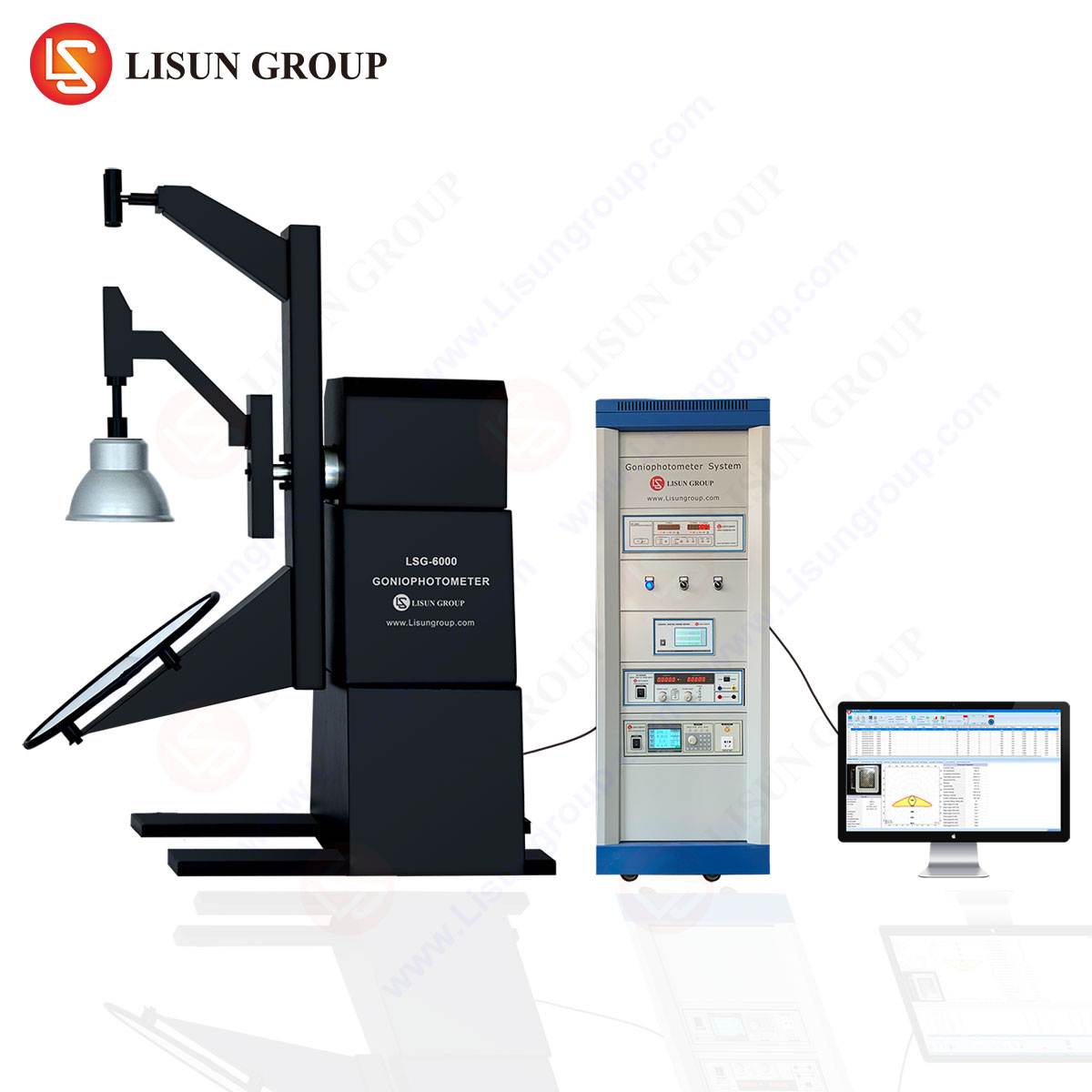
The LSG-1890B exemplifies a Type C goniophotometer, a configuration where the luminaire rotates about its own photometric center on both the vertical and horizontal axes. This design is optimal for measuring luminaires that are intended to be used in a fixed orientation, such as street lights, downlights, and most indoor commercial fixtures. The system’s mechanical architecture is predicated on extreme rigidity and precision engineering to minimize vibration and ensure the DUT’s photometric center remains stationary at the intersection of the two axes of rotation throughout the measurement sequence. The LSG-1890B employs a large-diameter, high-torque dual-axis rotation stage, capable of supporting luminaires up to 30 kg. The fixed, single-point far-field detector is positioned at a sufficient distance, typically 5 meters to 30 meters, to satisfy the inverse-square law approximation for photometric distance, ensuring accurate intensity measurements. The entire apparatus is controlled by sophisticated software that automates the scanning trajectory, data acquisition, and post-processing, transforming raw angular-intensity data into industry-standard photometric reports and files.
Table 1: Key Specifications of the LSG-1890B Goniophotometer System
| Parameter | Specification |
| :— | :— |
| Photometric Distance | 5m, 10m, 15m, 20m, 30m (configurable) |
| Maximum DUT Weight | 30 kg |
| Angular Resolution | 0.1° |
| C-Axis Rotation Range | 0° to 360° (continuous) |
| γ-Axis Rotation Range | -180° to +180° (or 0° to 360°) |
| Detector Options | High-precision photopic filter photometer or high-speed array spectroradiometer |
| Compliant Standards | IEC 60598-1, IESNA LM-79-19, CIE 121, CIE S025, EN 13032-1, ANSI C78.379 |
Spectral Radiance Integration in Photometric Analysis
The integration of a fast array spectroradiometer as the detector elevates a goniophotometer from a tool for purely photometric analysis to a comprehensive spatial color characterization system. For industries such as LED & OLED Manufacturing and Display Equipment Testing, this capability is non-negotiable. The LSG-1890B, when equipped with a spectrometer, captures the full spectrum (e.g., 380nm to 780nm) at each goniometric position. This allows for the generation of spatial color distribution maps, revealing inhomogeneities that are invisible in total flux measurements alone. For instance, a white LED downlight might exhibit a consistent total luminous flux but may have significant angular variation in CCT, shifting from a warm white at the center to a cool white at the periphery—a phenomenon known as spatial color uniformity or angular color shift. Quantifying this is essential for high-quality lighting products. The data supports calculations per standards like IEC 62906-5-2 for laser display components and is vital for Medical Lighting Equipment, where specific spectral power distributions are mandated for procedures and diagnostics.
Application in Solid-State Lighting Compliance and Development
The global adoption of LED technology has made precise goniophotometry a central pillar of product development and quality assurance. Standards such as IESNA LM-79-19, which governs the electrical and photometric testing of solid-state lighting products, explicitly require goniophotometric methods for accurate total luminous flux and intensity distribution measurement. The LSG-1890B facilitates full compliance with LM-79, as well as international equivalents like IEC 60598-1 and the European standard EN 13032-1. In LED & OLED Manufacturing, the system is used for binning LEDs based on spatial flux and color, validating thermal management design efficacy by measuring performance at elevated temperatures, and benchmarking against competitors. For OLED panels used in area lighting, the LSG-1890B can map the Lambertian characteristics and verify the extremely wide, uniform emission profile that is a key selling point of the technology.
Optimizing Architectural and Urban Lighting Designs
In Urban Lighting Design, the performance of a luminaire is not merely an on-paper specification but has direct implications for public safety, energy efficiency, and light pollution. The intensity distribution data from a goniophotometer is imported into lighting simulation software (e.g., DIALux, Relux) to model illuminance levels on roadways, pedestrian paths, and facades. The LSG-1890B provides the critical data needed to ensure compliance with standards such as the ANSI/IES RP-8 series for roadway lighting or the CIE 150:2017 guide on limiting obtrusive light. Designers can verify that a luminaire provides the required cut-off to minimize glare and uplight, contributing to Dark Sky initiatives. The system’s ability to handle heavy and large luminaires, such as post-top lanterns and high-mast sports lighting, makes it directly applicable to the municipal and architectural lighting sectors.
Precision Requirements for Stage, Studio, and Medical Lighting
The performance demands for Stage and Studio Lighting and Medical Lighting Equipment are exceptionally stringent, necessitating the granular data provided by advanced goniophotometry. Theatrical spotlights and studio fresnels require precise beam angle control, field flatness, and specific throw distances. The LSG-1890B’s high angular resolution (0.1°) allows for the detailed mapping of the beam’s edge, fall-off, and potential artifacts. For Medical Lighting, particularly surgical luminaires, standards like IEC 60601-2-41 specify requirements for depth of illumination, field diameter, and color rendering. A goniophotometer validates that the shadow dilution and light field homogeneity meet these critical safety and performance standards, ensuring that a surgeon has clear, consistent, and color-accurate visualization of the operative field.
Role in Photovoltaic and Optical Component Validation
While primarily a tool for emissive devices, goniophotometric principles are inversely applied in the Photovoltaic Industry and for Sensor and Optical Component Production. For photovoltaic (PV) modules, a goniophotometer can be used to characterize the angular response function—how the electrical output of a PV cell varies with the angle of incidence of light. This data is crucial for predicting the energy yield of PV installations throughout the day and year. Similarly, for optical components like diffusers, reflectors, and lenses, a goniophotometer can measure the Bidirectional Transmittance Distribution Function (BTDF) or Bidirectional Reflectance Distribution Function (BRDF). By using a stable integrating sphere source as the input and mounting the optical component as the DUT, the LSG-1890B can map how the component scatters or reflects light in 3D space, a critical parameter in Optical Instrument R&D.
Data Processing and Industry-Standard Output Formats
The raw data from a goniophotometric scan is a massive array of intensity (and optionally spectral) values. The sophistication of the system is largely embodied in its software’s ability to process this data into actionable intelligence. The software accompanying the LSG-1890B performs coordinate transformation to align the DUT’s mechanical axes with its photometric axes, integrates the luminous intensity over the spherical surface to calculate total luminous flux, and generates a wide array of outputs. These include:
- IES/LDT Files: The standard format for importing luminaire data into lighting design software.
- EULUMDAT Files: A common format in the European lighting community.
- Polar Candela Diagrams: Graphical representations of intensity distribution in the C0-C180 and C90-C270 planes.
- Isocandela Plots: 3D contour maps of luminous intensity.
- Luminous Flux Summary: Breakdown of flux into zones (e.g., uplight, downlight).
- Color Spatial Uniformity Maps: 2D false-color plots showing the variation of CCT, Duv, and CRI across the emission hemisphere.
Comparative Advantages of a Fully Integrated System
The competitive advantage of a system like the LSG-1890B lies in its integration, precision, and versatility. Unlike modular or simplified setups, it offers a turnkey solution calibrated as a complete system, reducing measurement uncertainty. The robust mechanical construction ensures repeatability over long-term use and with heavy DUTs. The flexibility in detector choice—from a high-speed photometer for rapid photometric scans to a research-grade spectrometer for full spatial-color analysis—makes it suitable for both high-throughput quality control labs and advanced Scientific Research Laboratories. Its compliance with a broad set of international standards ensures that data generated is recognized and accepted in global markets, from North America to Europe and beyond, facilitating international trade and product certification.
Frequently Asked Questions
Q1: What is the primary difference between using a photometer versus a spectroradiometer as the detector in the LSG-1890B?
A photometer, equipped with a V(λ) filter, measures photometric quantities (luminous intensity, flux) with high speed and precision. A spectroradiometer measures the full spectral power distribution at each point, enabling the calculation of both photometric and colorimetric data (CCT, CRI, chromaticity). The choice depends on whether spatial color information is required for the application.
Q2: How does the system account for the self-heating of LED luminaires during a measurement cycle that can take several hours?
The measurement software can implement a “stabilization check” by monitoring the photometric output at a reference angle at regular intervals. Furthermore, the standard IES LM-79-19 requires that the DUT be optically and thermally stabilized prior to the commencement of the goniophotometric scan. The system is designed for precise timing to ensure data consistency throughout the measurement.
Q3: Can the LSG-1890B measure the beam characteristics of a highly collimated light source, such as a laser headlamp or a searchlight?
Yes. For highly collimated sources, the system’s high angular resolution (0.1°) is critical to accurately map the narrow beam profile. The far-field distance must be chosen to be sufficiently long to resolve the fine structure of the beam, and the dynamic range of the detector must be adequate to handle the high peak intensities.
Q4: What is the significance of maintaining the photometric center at the intersection of the rotation axes?
Keeping the photometric center stationary is fundamental to the far-field condition and the validity of the inverse-square law used in the calculations. Any movement of the center would introduce a systematic error in the measured luminous intensity values, as the distance to the detector would vary with the angle.
Q5: Is the system suitable for measuring the transmissive or reflective properties of materials?
Yes, with a modified setup. By using a stable, calibrated light source in place of the DUT and mounting a material sample (e.g., a diffuser, reflector, or lens) on the rotation stages, the system can be configured to measure BTDF or BRDF, characterizing how the sample transmits or reflects light in different directions.