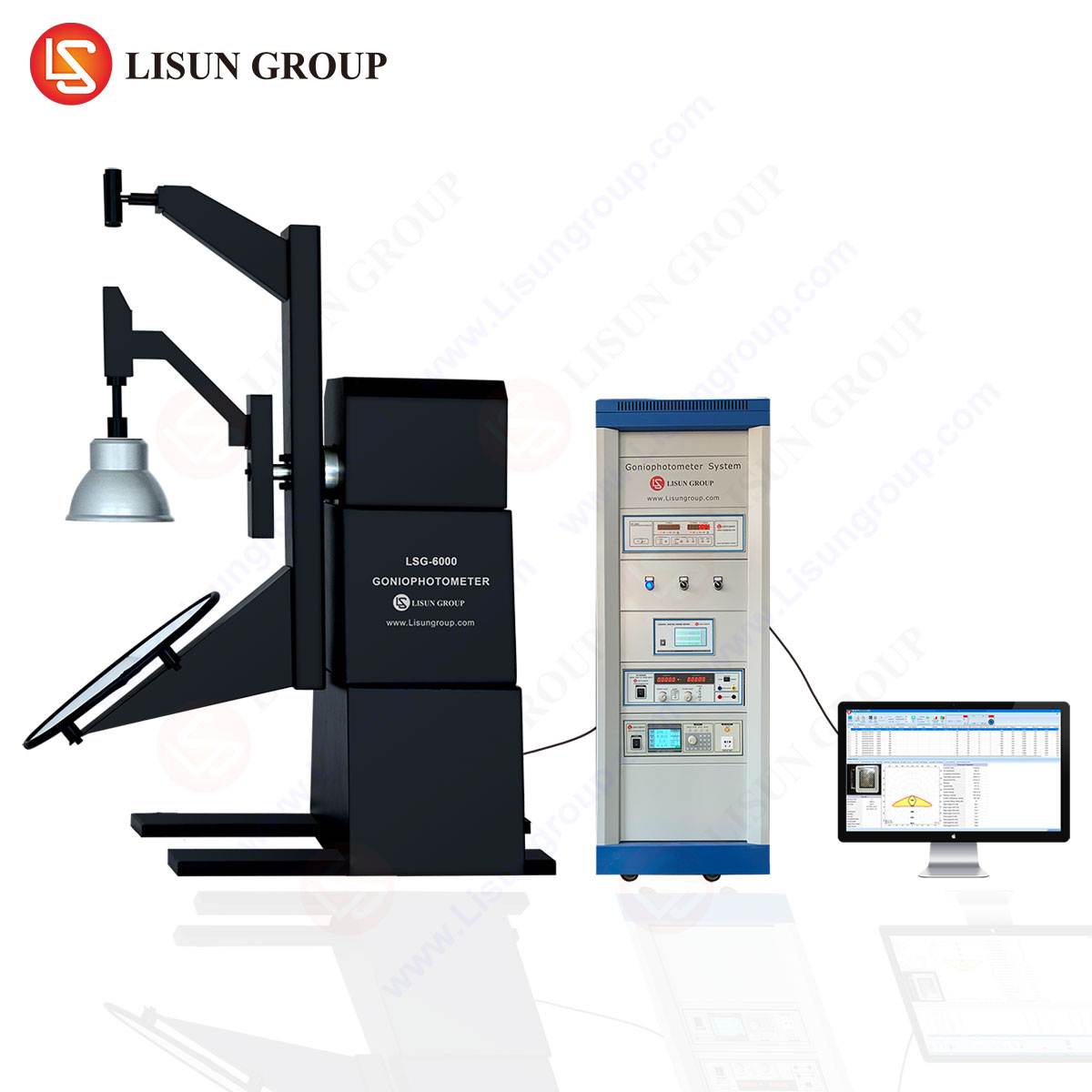



Advanced Goniophotometry for the Precise Characterization of Luminous Intensity Distribution
Introduction to High-Fidelity Photometric Spatial Analysis
The accurate quantification of a luminaire’s spatial light distribution—its luminous intensity distribution (LID)—is a cornerstone of applied photometry. This data, represented as an intensity matrix across spherical coordinates (C-γ or IESNA luminaire coordinate systems), is fundamental for predicting illuminance, calculating efficacy, ensuring regulatory compliance, and optimizing optical design. Advanced goniophotometry, the technique for acquiring this data, has evolved from manual point-by-point measurements to fully automated, high-resolution systems capable of capturing the complete photometric fingerprint of complex light sources. This article delineates the technical principles, implementation, and critical applications of modern Type C goniophotometer systems, with a specific examination of the LSG-6000 as a representative high-performance instrument.
Architectural Principles of a Type C Goniophotometer System
A Type C goniophotometer, as defined by standards such as CIE 70 and IES LM-79, employs a moving photodetector on a fixed arm that traces a spherical surface around a stationary luminaire. This configuration is optimal for maintaining the luminaire’s operational orientation (e.g., base-down for streetlights) and ensuring thermal stability during testing. The core system comprises several synchronized subsystems: a mechanically precise dual-axis rotation stage (azimuth and elevation), a spectroradiometer or high-accuracy photometer mounted on a rigid arm at a fixed distance, a darkroom or optical bench to eliminate ambient light, and a sophisticated control and data acquisition software suite. The LSG-6000 exemplifies this architecture, utilizing a horizontal rotation (C: 0°–360°) and a vertical arm rotation (γ: 0°–180° or 90°–90°) to achieve full 4π steradian spatial coverage.
Optomechanical Precision and Dynamic Range in the LSG-6000
The fidelity of the resultant intensity distribution curve (LIDC) is directly contingent upon the system’s mechanical accuracy and photometric dynamic range. The LSG-6000 incorporates a high-torque direct-drive servo system for both axes, achieving an angular positioning accuracy of ≤0.1°. This precision is non-negotiable for characterizing luminaires with sharp cut-offs, such as streetlights requiring stringent backlight and glare (UGR) control, or for measuring the narrow viewing angles of high-directionality LED modules used in optical instruments. The photometric detector, typically a class L (or superior) spectroradiometer with a cosine-corrected diffuser, is calibrated against NIST-traceable standards. The system’s large measurement distance (variable, but often 5m, 10m, or greater for the LSG-6000 to accommodate large luminaires) ensures measurements are conducted in the photometric far-field, satisfying the inverse-square law prerequisite. Its dynamic range, often exceeding 1:1,000,000, is essential for capturing both the high-intensity peak of a spotlight and the low-level stray light critical for contrast ratio analysis in display backlight units.
Data Acquisition Methodology and Spectral Integration
Modern systems like the LSG-6000 do not merely capture intensity; they acquire spectral radiance data at each angular coordinate. This allows for the simultaneous derivation of photometric (luminous intensity, flux) and colorimetric (chromaticity coordinates, CCT, CRI, Duv) spatial distributions. The testing principle involves a programmed scan, where the detector moves to predefined angular increments. At each point, the spectroradiometer captures the full spectral power distribution (SPD). The software then integrates this SPD with the CIE V(λ) luminous efficiency function to compute luminous intensity. This spectral-by-angle methodology is vital for industries where color consistency is paramount. For instance, in medical lighting for surgical applications, spatial color uniformity is as critical as intensity uniformity. Similarly, in museum and retail lighting, variations in CCT across the beam can distort perceived object colors, necessitating full spatial-color characterization.
Compliance with International Photometric Standards
Advanced goniophotometers are validation tools for global regulatory and performance standards. The LSG-6000 is engineered to facilitate testing in full compliance with a comprehensive suite of international protocols:
- IEC 60598-1 & Regional Derivatives (UL 1598, AS/NZS 60598): For general safety and performance requirements of luminaires.
- IES LM-79-19: Approved Method for the Electrical and Photometric Measurements of Solid-State Lighting Products, mandating goniophotometry for total luminous flux and intensity distribution.
- IES LM-63: Standard file format for electronic transfer of photometric data (IES files).
- EN 13032-4: Light and lighting – Measurement and presentation of photometric data – Part 4: LED luminaires and modules.
- DIN 5032-7: Photometric measurements of lamps and luminaires.
- ANSI C78.377: Specifications for the Chromaticity of Solid-State Lighting Products, validated through spatial color measurements.
- ISO 19476: Characterization of the performance of illuminance meters and luminance meters, relevant to system calibration.
This standards-based approach ensures that data generated is accepted by certification bodies like Intertek, TÜV, and DEKRA, and by design software such as Dialux, Relux, and AGi32.
Industry-Specific Applications and Use Cases
The utility of advanced goniophotometry spans diverse sectors, each with unique requirements met by systems like the LSG-6000.
- Lighting Industry & Urban Lighting Design: Generating IES files for accurate street lighting simulations, evaluating cut-off angles to minimize light pollution (addressing IDA Fixture Seal of Program criteria), and verifying compliance with roadway lighting standards (e.g., ANSI/IES RP-8, EN 13201).
- LED & OLED Manufacturing: Characterizing the spatial emission patterns of bare LEDs, COB arrays, and OLED panels. This is critical for secondary optics design and for binning LEDs not just by flux and color, but by spatial intensity profile.
- Display Equipment Testing: Measuring the angular luminance uniformity and contrast ratio of direct-lit and edge-lit LCD/LED TV backlights, and characterizing the viewing angle performance of micro-LED and OLED displays for consumer electronics and automotive dashboards.
- Stage and Studio Lighting: Precisely mapping the beam profiles, field angles, and intensity gradients of Fresnel lenses, PC spotlights, and moving-head luminaires to enable precise lighting plot planning in pre-visualization software.
- Medical Lighting Equipment: Validating the intense, uniform, and shadow-free field required in surgical lights (per IEC 60601-2-41), including measurements of depth of illumination and color rendering at various distances.
- Optical Instrument R&D and Sensor Production: Characterizing the angular response of lenses, diffusers, light guides, and optical sensors. This is essential for designing photovoltaic module encapsulants that maximize angular light capture or for calibrating the directional sensitivity of ambient light sensors in mobile devices.
Competitive Advantages of Integrated System Design
The LSG-6000 platform demonstrates several integrated advantages that address the limitations of modular or legacy systems. First, its fully sealed, standalone darkroom design eliminates the need for a dedicated darkroom facility, reducing installation footprint and environmental control costs. Second, the use of a spectroradiometer as the primary detector, rather than a filter-photometer, future-proofs the system against evolving metrics like TM-30 (Rf, Rg) and provides instant spectral data for every measurement point. Third, advanced software algorithms perform real-time background subtraction, temperature drift compensation, and automatic geometric factor calculations, ensuring laboratory-grade repeatability. Finally, its robust payload capacity (e.g., 50kg for the LSG-6000) and large test distance allow it to accommodate bulky and heavy luminaires, from high-bay industrial fixtures to full-sized automotive headlamps, which cannot be tested on smaller, table-top systems.
Data Outputs and Integration into the Design Workflow
The final output of a system like the LSG-6000 is not merely a data file; it is a comprehensive photometric passport for the luminaire. Key deliverables include:
- Standard IES (LM-63) and EULUMDAT (LDT) files for lighting design software.
- 3D isolux and iso-candela diagrams.
- Polar intensity plots (linear and logarithmic scales).
- Beam angle calculations (e.g., full width at half maximum – FWHM).
- Spatial maps of CCT, CRI, Duv, and other color metrics.
- Total luminous flux (lumens) derived from the goniophotometric scan, a method often more accurate than an integrating sphere for asymmetrical or large sources.
This data seamlessly integrates into the digital workflow, enabling virtual prototyping, regulatory submission, and quality assurance documentation.
Conclusion
The advanced goniophotometer, as embodied by systems like the LSG-6000, represents an indispensable synthesis of precision mechanics, optoelectronics, and software analytics. It transforms the subjective assessment of light into an objective, standardized, and richly detailed spatial dataset. As lighting technologies continue to advance in complexity and application specificity—from human-centric lighting to LiDAR illumination—the role of high-resolution spatial photometry will only expand. The ability to rigorously characterize luminous intensity distribution remains fundamental to innovation, quality, and efficacy across the vast spectrum of industries that depend on the controlled application of light.
Frequently Asked Questions (FAQ)
Q1: What is the primary advantage of a Type C goniophotometer (moving detector, fixed luminaire) over a Type A (moving luminaire) system for testing thermal-sensitive LEDs?
A Type C system maintains the luminaire in a fixed, often operational, orientation throughout the test. This is critical for LED products where thermal management is orientation-dependent. A stationary position ensures the junction temperature and thermal pad contact remain consistent, preventing measurement artifacts caused by changing thermal performance during rotation, which can affect both light output and spectral characteristics.
Q2: Can the LSG-6000 system measure near-field luminous intensity, and what are the limitations?
While primarily designed for far-field measurements (to satisfy the inverse-square law), systems can be configured for near-field goniophotometry (NFP) by reducing the measurement distance and using a luminance camera. However, standard LSG-6000 operation with a single-point detector in the near-field requires careful application of the photometric distance law and is generally not recommended for generating standard IES files. Dedicated NFP systems using imaging technology are better suited for this specific application.
Q3: How does the system account for the self-absorption error when testing luminaires with large physical size relative to the measurement distance?
For large luminaires where the detector cannot be placed at a distance ≥5 times the largest source dimension (the 5x rule), the software employs geometric distance factor corrections. The LSG-6000 control software calculates the exact vector distance between the luminaire’s photometric center and the detector for each angular position, applying a precise inverse-square law correction. This compensates for the variation in measurement distance across different gamma angles, ensuring accurate intensity values.
Q4: What calibration procedures are required to maintain the traceability and accuracy of the system?
Maintaining traceability requires a regular calibration regimen: 1) Annual calibration of the reference spectroradiometer against a NIST-traceable standard lamp for spectral responsivity and absolute irradiance. 2) Verification of the angular positioning accuracy using laser alignment tools or calibrated angle artifacts. 3) Regular validation of the entire system using a stable, calibrated reference luminaire with a known IES file, comparing measured results to the certified data.
Q5: For photovoltaic industry testing, what specific parameters can be derived from goniophotometric measurements of a solar module’s optical encapsulant?
While not measuring the PV cell’s electrical output, goniophotometry of encapsulant materials or finished modules characterizes optical performance. Key parameters include the angular-dependent transmittance profile, which reveals the effectiveness of light-trapping structures, and the spatial distribution of scattered light. This data is used to optimize encapsulant formulations and surface textures to maximize the capture of diffuse and oblique light, thereby increasing the module’s effective daily energy yield.