


A Comprehensive Guide to Goniophotometer Classification
Introduction to Photometric Spatial Distribution Analysis
The accurate characterization of a light source’s spatial radiation pattern is a fundamental requirement across numerous scientific and industrial domains. Unlike a simple measurement of total luminous flux, which provides an aggregate output, understanding how light is distributed in space is critical for applications ranging from energy-efficient architectural illumination to the precise calibration of medical diagnostic equipment. The primary instrument engineered for this sophisticated task is the goniophotometer. This device measures the luminous intensity distribution of a light source by rotating it through a series of spherical coordinates, typically azimuth (C-plane) and elevation (γ-plane), while a fixed photodetector captures the angular light output. The resulting data set, often visualized as an isolux diagram or an intensity distribution curve, forms the basis for calculating total luminous flux, efficacy, and other key photometric parameters. The classification of these complex instruments is not arbitrary; it is dictated by their mechanical configuration, measurement methodology, and intended application, each with distinct implications for accuracy, speed, and the types of luminaires that can be tested.
Fundamental Principles of Goniophotometric Operation
At its core, a goniophotometer operates on the principle of coordinate transformation. The luminaire under test (LUT) is treated as the origin of a spherical coordinate system. The instrument systematically repositions the LUT relative to a photometer, which remains at a fixed distance to satisfy the far-field condition for photometry. The fundamental equation governing the calculation of total luminous flux (Φv) from goniophotometric data is derived from the integration of luminous intensity (Iv) over the entire solid angle of a sphere:
Φv = ∫ Iv(θ, φ) dΩ
Where:
- Φv is the total luminous flux in lumens (lm).
- Iv(θ, φ) is the luminous intensity in candelas (cd) as a function of the vertical (θ) and horizontal (φ) angles.
- dΩ is the differential solid angle in steradians (sr).
The mechanical implementation of this spherical scanning defines the primary classification of goniophotometers. The two principal architectures are Type A (moving detector) and Type B (moving lamp), as defined by standards such as CIE 70 and IES LM-79. In a Type A system, the LUT rotates around a vertical axis (azimuth) while the detector moves along a vertical arc (elevation). Conversely, in a Type B system, the LUT rotates around both a horizontal and a vertical axis, simulating the movement of a point source, while the detector remains stationary. The choice between these types significantly impacts the measurement of luminaires with direction-dependent characteristics, such as those with asymmetric light distributions or integrated heat sinks whose thermal performance is orientation-sensitive.
Taxonomy of Goniophotometer Mechanical Architectures
The mechanical design of a goniophotometer is the most salient feature for its classification. Each architecture presents a unique set of advantages and constraints, making it suitable for specific testing scenarios.
Type C Mirror Goniophotometers: This design utilizes a rotating mirror system to redirect light from the stationary LUT to a fixed photometer. The LUT is typically mounted on a platform that can rotate horizontally, while a large, precisely shaped mirror rotates on a vertical arm to capture light from different vertical angles. The primary advantage of this system is the ability to keep the LUT in a fixed position, which is crucial for testing luminaires whose thermal and photometric stability are highly sensitive to orientation, such as high-bay industrial LED fixtures or certain OLED panels. This configuration minimizes the influence of convective heat flow changes that can occur when a luminaire is tilted.
Type A and Type B Articulating Arm Systems: These are the most common configurations for general-purpose testing. Type A systems, where the detector moves, are often preferred for measuring luminous intensity distributions, as the LUT’s orientation relative to gravity remains constant, ensuring consistent thermal performance. Type B systems, where the LUT is rotated around two axes, are traditionally considered the reference geometry for total luminous flux measurement, as they directly simulate the geometry of an integrating sphere. Modern high-precision systems, however, can achieve exceptional accuracy with either type when properly calibrated and characterized.
Robotic Arm and Multi-Axis Configurations: For highly specialized applications, particularly in the display equipment testing and optical component production sectors, multi-axis robotic goniophotometers are employed. These systems offer unparalleled flexibility, capable of positioning a detector or a source with multiple degrees of freedom. This is essential for characterizing the angular dependence of micro-LED arrays, the view-angle performance of display pixels, or the bidirectional reflectance distribution function (BRDF) of optical materials and sensors.
The LSG-6000: A Benchmark in Large-Area Luminance and Luminous Flux Measurement
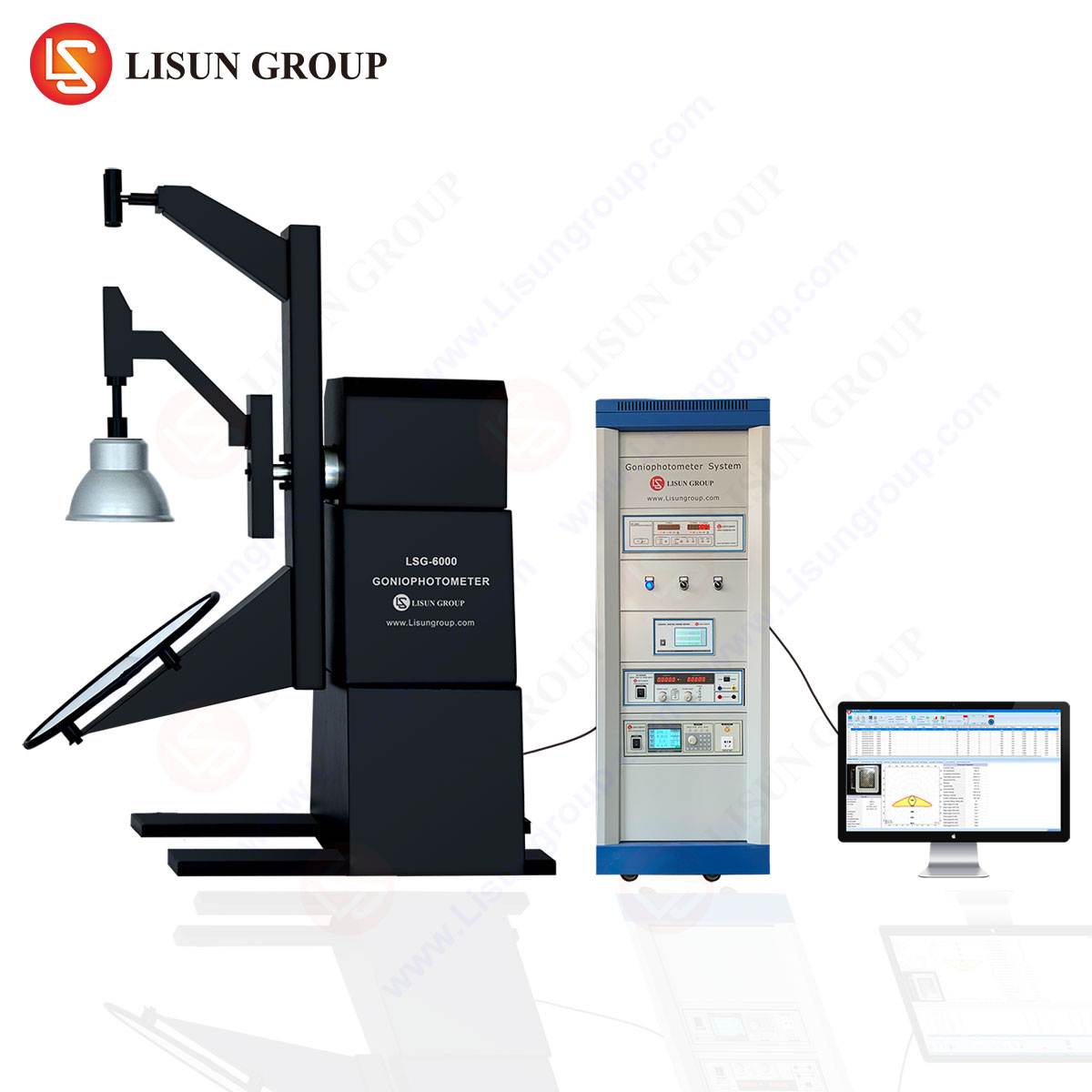
The LISUN LSG-6000 represents a state-of-the-art implementation of a Type C mirror goniophotometer, engineered to address the demanding requirements of modern, large-scale luminaires. Its design is optimized for precision and operational efficiency in testing products from the lighting industry, urban lighting design, and stage and studio lighting sectors.
Specifications and Testing Principles:
The LSG-6000 features a large darkroom and a robust mechanical structure with a 5-meter photometric distance, accommodating luminaires with lengths up to 2,000mm. It employs a high-precision servo-motor control system for both the rotating mirror and the turntable, ensuring smooth and accurate angular positioning. The system integrates a high-sensitivity, spectrally corrected photometer or a high-resolution CCD imaging luminance meter, allowing for simultaneous measurement of luminous intensity distribution and luminance distribution. The testing principle relies on the stationary mounting of the LUT. The horizontal turntable rotates the luminaire in the azimuth plane, while the vertically rotating mirror captures light at different elevation angles (γ-angles from 0° to 180° or C-angles from 0° to 360°), directing it to the fixed detector. This method ensures that the thermal and electrical operating conditions of the LUT remain stable throughout the measurement cycle, a critical factor for obtaining accurate and repeatable data for thermally sensitive LED systems.
Industry Use Cases and Standards Compliance:
The LSG-6000 is designed for compliance with a wide array of international standards, making it a versatile tool for global markets. Its application is critical in industries requiring rigorous photometric validation.
- Lighting Industry & LED Manufacturing: It is used to verify compliance with standards such as IES LM-79 (Electrical and Photometric Measurements of Solid-State Lighting Products), IES LM-63 (Standard File Format for Electronic Transfer of Photometric Data), ANSI C78.377 (Specifications for the Chromaticity of Solid-State Lighting Products), and ENERGY STAR program requirements.
- Display Equipment Testing: For measuring the angular luminance uniformity and contrast ratio of large displays and signage, adhering to methodologies outlined in IEC 62547 (Guidelines for the measurement of high-power laser beams).
- Urban and Street Lighting Design: The system generates the IES files necessary for lighting design software (e.g., Dialux, Relux) to simulate and optimize street lighting layouts, ensuring compliance with roadway lighting standards like ANSI/IES RP-8.
- Stage and Studio Lighting: It characterizes the beam angle, field angle, and fall-off patterns of spotlights and floodlights, providing data essential for lighting designers in film, television, and theater.
Competitive Advantages:
The LSG-6000’s primary advantage lies in its ability to test large and heavy luminaires in their operational orientation, eliminating thermal management artifacts that can skew data from articulating-arm systems. Its fully automated operation, coupled with sophisticated software for data analysis and report generation, significantly reduces measurement time and operator error. The integration of an imaging luminance meter further extends its capability beyond conventional photometry, allowing for detailed spatial analysis of luminance patterns across the face of a luminaire, which is invaluable for quality control in LED panel manufacturing.
Advanced Measurement Modalities: Spectroradiometry and Imaging Photometry
While traditional goniophotometers employ a single-point photodetector, advanced systems integrate more sophisticated sensors to capture a richer data set. The integration of a spectroradiometer transforms a standard goniophotometer into a spectrogoniophotometer. This allows for the measurement of the complete spectral power distribution (SPD) at every angular position. The data derived from this is critical for calculating colorimetric quantities such as Correlated Color Temperature (CCT), Color Rendering Index (CRI), and chromaticity coordinates (x, y) as a function of angle. This is indispensable in LED & OLED Manufacturing and Optical Instrument R&D, where angular color shift can be a critical failure mode.
The incorporation of an imaging photometer or a CCD-based luminance camera creates an imaging goniophotometer. Instead of measuring a single point, this system captures a high-resolution 2D luminance map of the LUT from each angular viewpoint. This modality is essential for Display Equipment Testing to assess Mura effects (non-uniformity) and for Sensor and Optical Component Production to evaluate the angular response of lenses and diffusers. It provides unparalleled insight into spatial artifacts that a single detector would average out and miss entirely.
Navigating International Standards for Goniophotometric Compliance
Adherence to international standards is not merely a matter of regulatory compliance; it is the foundation for ensuring measurement reproducibility, data integrity, and fair comparison of products across the global market. Goniophotometer selection and operation must be aligned with the relevant standards for the target industry and region.
- IEC 60598-1 (Luminaires – General Requirements and Tests): This overarching standard specifies safety and performance requirements, often referencing the need for photometric testing.
- IES LM-79-19 (Approved Method: Electrical and Photometric Testing of Solid-State Lighting Products): This is a cornerstone standard for the SSL industry in North America, detailing the procedures for measuring total luminous flux, luminous intensity distribution, and color characteristics, explicitly describing the use of goniophotometers.
- CIE 70-1987 (The Measurement of Absolute Luminous Intensity Distributions): This publication provides the fundamental framework and recommendations for goniophotometer design and measurement practices.
- EN 13032-1 (Light and lighting – Measurement and presentation of photometric data of lamps and luminaires): This European standard is harmonized with many EU directives and provides detailed requirements for the quality of photometric data, including goniophotometric methods.
- ANSI/IES RP-16-17 (Nomenclature and Definitions for Illuminating Engineering): This standard provides the definitive terminology used in photometry, ensuring clear communication of goniophotometric results.
For the Photovoltaic Industry, while goniophotometers are not used for PV cell testing, the principles are applied in specialized instruments that measure the angular acceptance of sunlight for concentrator photovoltaic (CPV) systems. The LSG-6000, with its precise angular control, could be adapted for such research and development tasks.
Selection Criteria for Application-Specific Goniophotometry
Selecting the appropriate goniophotometer requires a systematic evaluation of technical requirements against operational constraints. Key criteria include:
- Luminaire Size and Weight: The physical capacity of the goniophotometer’s mount and the dimensions of the darkroom are primary constraints. Systems like the LSG-6000 are designed for large-area luminaires, whereas smaller robotic systems are suited for micro-optics.
- Measurement Accuracy and Speed: The required accuracy, dictated by the application (e.g., scientific research vs. production line QC), will influence the choice of detector, mechanical precision, and measurement methodology (point-by-point vs. continuous scanning).
- Photometric versus Spectroradiometric Data: The need for angular color data necessitates the integration of a spectroradiometer, increasing system cost and complexity.
- Thermal Sensitivity of the LUT: For luminaires whose junction temperature and thus light output are highly dependent on orientation, a Type C (mirror) or Type A system is strongly preferred over a Type B system to maintain a constant thermal state.
- Data Output Requirements: The required deliverables, such as IES, LDT, or EULUMDAT files for lighting design software, must be supported by the system’s analysis software.
Conclusion: The Critical Role of Precise Classification
The classification of goniophotometers is a direct reflection of their underlying physical principles and intended metrological purpose. From the mirror-based architecture of the LSG-6000, ideal for stable thermal testing of large luminaires, to the flexible robotic arms used for display and sensor characterization, each class serves a distinct and vital role in the lighting and optics value chain. A deep understanding of this taxonomy enables engineers, researchers, and quality assurance professionals to select the optimal instrument, apply the correct international standards, and ultimately generate photometric data of the highest fidelity. This precision is the bedrock upon which advancements in energy efficiency, visual comfort, and optical innovation are built.
Frequently Asked Questions (FAQ)
Q1: Why is a Type C (mirror) goniophotometer like the LSG-6000 often recommended for testing high-power LED luminaires?
High-power LED luminaires are highly sensitive to thermal conditions. Their junction temperature, and consequently their light output and color, can change significantly with orientation due to variations in convective cooling. A Type C system keeps the luminaire stationary in its normal operating position, ensuring a consistent thermal state throughout the measurement, which leads to more accurate and repeatable photometric and colorimetric data compared to systems that tilt the luminaire.
Q2: Can a goniophotometer be used to measure the efficacy (lm/W) of a lighting product?
Yes, absolutely. Goniophotometry is a primary method for determining total luminous flux (lumens), which is a key component of efficacy. The goniophotometer measures the angular light output, from which total flux is calculated via software integration. This luminous flux value is then divided by the electrical power input (Watts) measured during the test to calculate the efficacy of the product.
Q3: What is the difference between measuring luminous intensity distribution and luminance distribution?
Luminous intensity distribution describes how much light (in candelas) is emitted in each direction from the entire luminaire. Luminance distribution, measured with an imaging luminance meter, describes the brightness (in candelas per square meter) of the luminous surface itself as seen from each direction. Luminance data is crucial for assessing glare and visual comfort, particularly for products like LED panels and office luminaires.
Q4: How does the LSG-6000 ensure compliance with international standards like IES LM-79?
The LSG-6000 is designed and calibrated to meet the stringent requirements outlined in IES LM-79. This includes maintaining the required photometric distance, using a spectrally corrected detector, ensuring precise angular positioning, and operating within a properly controlled environmental chamber. Its software is programmed to execute the measurement sequences and data processing algorithms specified by the standard, and it outputs data in the standard IES file format for photometric data exchange.